

There’s a huge penalty on having a baby that no one talks about, no scratch that, a huge penalty on becoming a MUM that we rarely talk about, and even when we do, it’s never talked about enough.
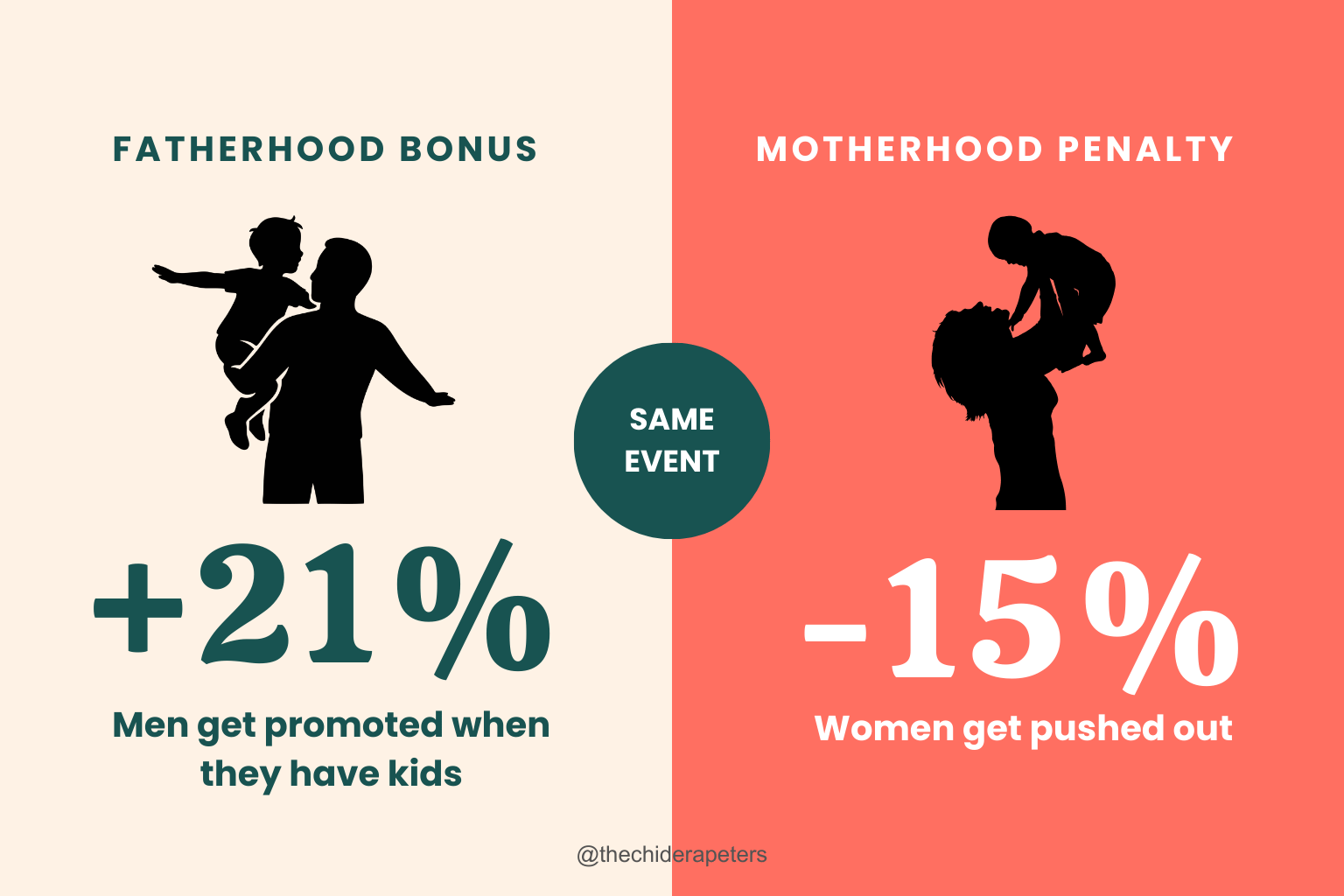
According to research by the TUC and the Institute for Public Policy Research (IPPR), men who work full-time experience a 21% “wage bonus” when they become fathers. Meanwhile, women who become mothers before the age of 33 typically suffer a 15% pay penalty.
Can you imagine? It’s literally the same life event but opposite financial outcomes.
I actually watched a movie where a group of men were about to close out a business deal, and the investor, just before signing the dotted lines, asked his soon-to-be new partner if he had kids. This new partner did not have kids but could tell from the tone of the question and their prior conversation that having kids could be a plus for him, so he lied and said he did. The investor proceeded to sign the papers because according to him, “a man with kids can be trusted as you have a stronger sense of financial responsibility.”
You might argue that’s just a movie, but it’s not. The data backs this up in a big way. A Fawcett Society poll found that nearly half (46%) of people think women are less committed to their work after becoming parents, while three in ten (29%) think men are MORE committed to their jobs after having a baby.
Men get promoted when they have kids. Women get pushed out.
A woman being a mum is seen as a disadvantage, and there will be so many assumptions ranging from “she won’t have the time” to “she won’t be as focused” and everything in between.
The Numbers Are Staggering
The Office for National Statistics (ONS) published an analysis in October 2025 that put hard numbers to what many of us already know. Five years after the birth of a first child, mothers’ monthly earnings are on average 42% lower than in the year before birth.
For mothers of three, the total earnings loss over five years amounts to more than £124,000.
And this doesn’t even account for the long-term impact on pensions. According to Royal London, women can miss out on nearly £92,000 in pension savings over 12 years by juggling caring responsibilities and working part-time. If you leave work altogether, you could be looking at a £183,000 pension hole.
Getting pregnant and having a baby should be something that is encouraged, given declining world populations, and also celebrated by all.
A woman literally puts her life on the line to have a child, and rather than being treated like the hero that she is, she gets to deal with the snap back police, hostile workplaces, and a financial uphill battle.
I’ve had lots of women ask me how to financially prepare for maternity leave or how to make the most of the Statutory Maternity Pay (SMP) that they’re forced to live on. In an ideal world, a woman who chooses to keep the human race going should not have to bear the brunt of her own financial survival. Motherhood is hard enough already.
So If You’re Reading This as a Woman Who Hopes to Have Kids Someday, What Should You Do?
1. Understand and accept the sacrifice
As with everything in life, seasons come and go. Before you become a mum, please sit with the idea for a while and consider all the many lifestyle and financial changes you would face. Then accept that for a season you’re okay to prioritise being a mum over financial success. This sucks, but I am keeping it real with you.
2. Consider the costs and plan for your maternity leave
A baby typically gives you months of advance notice (except in certain circumstances). Once you decide you would like to have a baby, and notice I didn’t say once you’re trying for a baby or married, even as a single lady who desires to have a baby at some point, open up a Maternity Fund and start keeping money in it.
This is super critical so you can spend time with your baby during postpartum without having to worry about money. If I ever consider having a baby again, this is the first thing I will tackle aggressively. Without this, financial considerations will have you cutting short your precious time with your little one.
Just to share here, my partner and I had “Childcare Savings” which is money we saved up and are still saving for all child-related costs. But I wish I had a “Maternity Fund” which is solely for looking out for myself and replacing my salary so I could take up to one year of maternity leave.
3. Check and know your maternity leave policy
Before you take on a new job, beyond the financial compensation, also consider their maternity leave policy and how supportive the company is, especially if you’re in a season where you’re strongly considering motherhood.
4. Upskill during your maternity leave
During your maternity leave, in the margins of your day (yes, margins, because taking care of a baby sucks up all the time), find ways to upskill. Take up a relevant course or improve on a key skill you need at work.
Also use this time to become a LinkedIn pro, and by that I mean treating “LinkedIn” as work where you clock in at least once or twice a week with a thought leadership post in your field. I did this during my maternity leave for 30 days straight and it made a difference as I began to get more inbound leads for open roles.
5. Document everything
You probably already know this as a rule of the workplace: follow up every conversation or meeting with an email recap to ensure everyone is on the same page. This is even more important when you’re pregnant.
From the moment you’re pregnant, you’re in a vulnerable state, and it’s super critical that you protect yourself. If it’s not written, it did not happen. Put every promise, hostile remark, and unfavourable treatment down in writing. It will come back super helpful should you need it.
And If You’re an Employer Reading This
1. Create a supportive environment for working mums.
I recently read that the American Express office in London has dedicated nursing rooms for mothers where they can go to breastfeed or pump, access to lactation consultants, and flexible return-to-work arrangements for mothers returning from leave. This is the kind of support that makes a difference.
2. Recognise that mothers are often MORE productive, not less:
A study from the Federal Reserve Bank of St. Louis that examined 10,000 academic economists found that over a 30-year career span, mothers outperformed women without children at almost every stage. What’s more, mothers with two kids were the most productive of all.
Yes, there’s a dip when children are young, but when you look at an employee’s value over their entire career rather than just the baby years, mothers consistently come out on top. They’ve learned time management, efficiency, and how to prioritise like nobody else.
3. Offer genuine flexibility
Not "flexible" in name only, but actual support through flexible hours, remote working options, and understanding that school pick-ups and sick children are part of life.
4. Keep her role and give her a chance
Don’t demote a woman or strip her responsibilities based on assumptions about what she can or can’t handle now that she’s a mum. Have a conversation with her instead.
Many women return from maternity leave to find their role has been quietly reduced or given to someone else. With the right support and flexibility, she can thrive in the same role she had before, and sometimes even better.
The motherhood penalty is real. It’s not a myth or an excuse, and it’s not something women bring upon themselves. It’s a systemic issue that requires systemic solutions.
But until those solutions arrive, we need to protect ourselves. Plan ahead. Save aggressively. Document everything. And know your worth, because becoming a mother doesn’t diminish it.
XOXO,
Chidera 💰
Well written 👏🏾👏🏾
Apt