

Last week I read the story of a woman called Perry in The Telegraph who built a £2 million investment portfolio from just £2,400 by staying consistent, diversified, and invested over the years.
Perry didn’t come from a wealthy family and knew little to nothing about investing. But in 1987, during the wave of privatisations, she drained her cash savings account, bought shares in BT, and opened a Personal Equity Plan (that later became Stocks & Shares ISA).
She was a working class woman on an average salary who made a decision to start and then kept going for nearly 40 years.
The result? A £2 million in an ISA. Tax-free.
Perry’s story isn’t unusual because she had some secret advantage. It’s unusual because most people never start. They assume building serious wealth requires a business, an inheritance, or a salary they don't have, when really it just takes a regular income, discipline, and time.
📊 The Maths Is On Your Side
The average full-time salary in the UK is about £39,000 a year.
After tax, rent, and bills, it can feel like there’s barely anything left.
But becoming a millionaire from your salary isn’t about how much you earn. It's about how much you keep and how early you start.
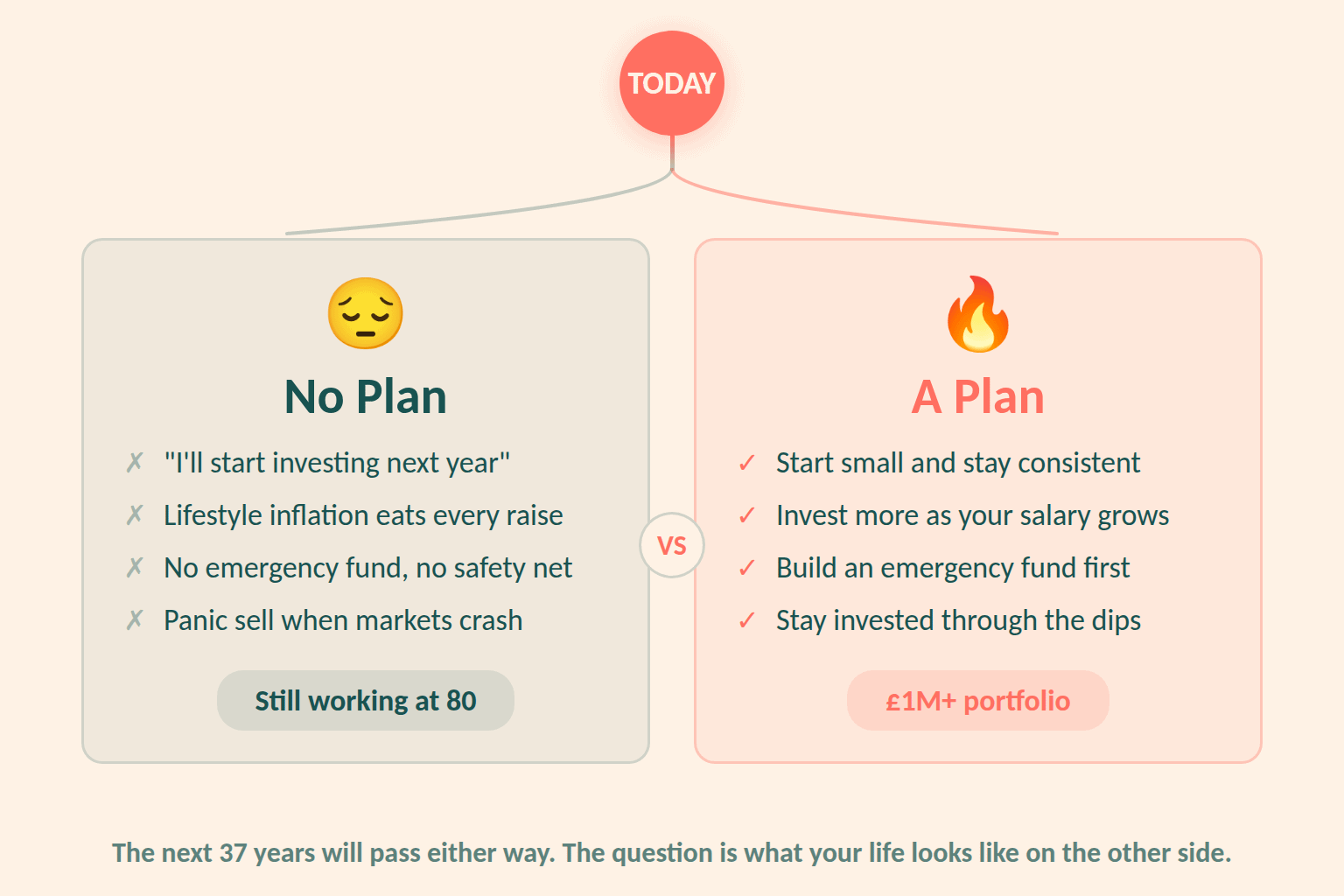
If you invested £500 a month into a global index fund returning an average of 7% per year after inflation (which is roughly what the S&P 500 has delivered historically), you’d have over £1 million in about 37 years.
You might hear 37 years and feel like that’s a lifetime away. But I watched something last week that completely reframed that number for me.
😔 The Video I Can’t Stop Thinking About
Business Insider released a video featuring people in their 80s who are still working, not because they want to, but because they have no choice.
An 84-year-old Uber driver. An 82-year-old who said “I wish I could retire now” but has zero retirement savings. A 81-year old substitute teacher who has to work in order to eat.
These aren’t people who sat around doing nothing with their lives. They had real careers and serious qualifications.
One man had a degree in mathematics and worked as a computer programmer. And later became the vice president of a company developing advanced communication systems, earning $115,000 a year at the peak of his career, which was serious money at the time 👀.
Despite that, he panicked during a stock market crash, sold all his investments, and later had to drain his retirement fund just to get by and that he tries not to think about it because he’d “wake up in the middle of the night screaming. What did you do? You were a fool”
Despite his maths degree, despite decades of high-level work, he said: “I might have a degree in mathematics, but it doesn’t mean I’m financially literate.”
That’s the part that stuck with me.
Financial literacy has nothing to do with how smart you are, how hard you work, or how much you earn. It’s a completely separate skill. And without it, even the highest earners can end up with nothing.
Another woman who earned $100,000 at the peak of her career said “I just wish I had enough passive income that I could do whatever I want without trading hours for dollars”
Another person in the video said: "I kind of wish I would have known about the thing if you just save like $25 a month with compound interest, starting at age 25, that you'll be a millionaire by some 65 or 70 or something." They know that now.
But knowing it at 80 is very different from knowing it at 25.
So when I say it takes 37 years to reach £1 million, those years might feel far away right now. But it doesn't have to take 37 years.
You could earn higher returns, invest more as your salary grows, add occasional lump sums. There are so many ways to speed that timeline up.
But even if it does take 37 years, every person in that video will tell you the same thing: it goes by faster than you think. And when you get there, you'll either have options or you won't.
✅ 7 Things You Can Do Right Now To Be Financially Ahead of Most People
The good news? You’re reading this, which means you still have time. Financial literacy isn’t something they teach in school, but it is something you can learn.
1. Know exactly where your money goes every month. You can’t build wealth from money you can’t account for.
2. Start investing something, even if it’s small: Perry started with £2,400. The man in the video wished he’d started with $25 a month. The habit matters more than the amount
3. Build an emergency fund: The biggest reason people lose their path to wealth is because they pull money out their investments during a personal crisis. Even three months of essential expenses in a savings account protects your long-term plan.
4. Don’t panic when the market dips: The man with the maths degree sold everything during a crash and never recovered. Markets go down, and that’s normal. The people who lose money are almost always the ones who sell during a downturn.
5. Increase your contributions every time your income goes up. Every time you get a raise or a bonus, redirect a portion into your investments before your lifestyle adjusts to the new number.
6. Treat your career as a wealth-building tool. Your salary is what funds everything. Negotiating raises, switching jobs strategically, and investing in skills that increase your earning power all compound over time just like your investments do.
7. Get financially literate on purpose. Nobody is coming to teach you this. Not your school, not your employer, not the government. Even a basic understanding of budgeting, investing, and compound interest puts you ahead of most people. That’s why this newsletter exists.
Perry’s advice to anyone thinking about investing? “You don’t have to know anything about it. Invest small sums regularly.”
That’s it. That’s how you become a millionaire from little. You start, you stay consistent, and you let time do what time does.
Before you go...
If this email made you think differently about what’s possible, forward it to someone who needs to hear it.
And if you’re ready to start building wealth through investing, my 6-week programme The Money Method walks you through everything from understanding your numbers to building a portfolio that works for you. The next cohort starts soon.
XOXO,
Chidera 💰